



In brief: Myopia (nearsightedness) is a condition in which nearby objects look clear, while distant objects look blurry. It occurs when the eye is slightly longer than usual or the cornea is too curved, causing light to focus in front of the retina. It usually develops during school age and progresses until around age 20. In children, spending time outdoors lowers the risk of developing myopia, and myopia control can slow its progression. Myopia does not go away on its own: it is corrected with glasses or contact lenses, and in adults with a stable prescription, with laser surgery or ICL lenses.
What is myopia?
In an eye with no refractive error, the cornea and lens focus light precisely on the retina. With myopia, the eyeball is slightly longer from front to back, or the cornea is too curved. Light focuses in front of the retina, making distant objects look blurry. The eye sees well up close, for example when reading.
A glasses prescription for myopia is written with a minus sign and measured in diopters (D), for example −2.00 D. According to the American Academy of Ophthalmology (AAO) classification, myopia below 3 diopters is mild, from 3 to 6 diopters is moderate, and above 6 diopters (a glasses prescription stronger than −6.00 D) is high myopia.
Myopia is very common and is becoming more prevalent worldwide. The AAO estimates that by 2050, nearly half of the world’s population may be nearsighted.
What are the signs of myopia?
The most common signs in adults are:
- road signs, the TV, or distant faces look blurry;
- you squint to see more clearly;
- your eyes feel tired and you have a headache.
Young children with myopia often don’t complain that their vision is blurry. Parents may notice that their child:
- can’t read the board in class;
- sits very close to the TV or holds their phone very close to their face;
- rubs their eyes often or complains of headaches.
Mild myopia may not cause any symptoms. That’s why we recommend eye exams even when a child has no complaints. Find out when and how often to have an eye exam at every age in our guide to how often you should have an eye test.
Why does myopia develop, and why is it becoming more common in children?
The exact cause is not fully understood, but three factors are known:
- Heredity. The risk is higher when parents or other relatives are nearsighted.
- Time indoors and limited natural light. Children who spend a lot of time indoors are at greater risk, while those who spend more time outside in sunlight are less likely to become nearsighted.
- Growing age. Myopia usually starts between the ages of 6 and 14 and progresses as the eye grows, until around age 20. It changes little between ages 20 and 40.
The earlier myopia starts, the higher the risk of it becoming high myopia in adulthood. That’s why we monitor children with myopia regularly.
Myopia in children: how can it be slowed?
In children, the progression of myopia can be slowed; this is called myopia control. Regular glasses correct vision, but do not stop the prescription from increasing. At our clinic, myopia control in children involves special glasses, low-dose atropine eye drops, multifocal contact lenses, orthokeratology, and changes to daily activities. The aim is to slow the worsening of myopia and the elongation of the eye as it grows.
| Method | How it works | What to know |
|---|---|---|
| More time outdoors | natural light is associated with less myopia | we recommend at least 1–2 hours outdoors a day and no more than 1–2 hours of screen time a day |
| Low-dose atropine eye drops | one drop daily, before bed, for several years | according to the AAO, they stop or slow myopia in about 7 out of 10 children; they may cause redness or itching around the eye |
| Special glasses or multifocal contact lenses | change the focus in the peripheral field of vision | can slow myopia, but they don’t work equally well for every child; contact lenses carry a risk of infection and require careful hygiene |
| Orthokeratology (rigid lenses worn at night) | temporarily flatten the cornea | clear vision without glasses during the day; there is a risk of serious infections that can damage vision, so the child needs close monitoring |
We decide which option is right for your child after a complete examination, taking into account their age, prescription, and how quickly it is progressing. Learn what to expect during your child’s appointment in our guide to an eye doctor for children.
From Dr. Nishant Taneja’s experience: We advise parents to make sure their child spends more time outdoors and takes breaks from screens. This helps alongside the treatment we choose to control myopia.
Can myopia be cured? Correction options for adults
Myopia does not go away on its own, but it can be corrected. There is no scientific evidence that eye exercises, vitamins or tablets can prevent or cure it. Glasses and contact lenses correct vision while you wear them. For adults whose prescription is stable, laser surgery or an ICL lens can correct their prescription.
| Method | For whom | Notes |
|---|---|---|
| Glasses | Any age | The prescription is updated if it changes |
| Contact lenses | Adults and some children | Lens hygiene is important |
| Laser: SMILE Pro, Femto-LASIK, PRK | Adults with a stable prescription | The laser reshapes the cornea |
| ICL lens | Very high prescription or thin cornea | The lens is placed inside the eye, between the iris and the natural lens, through a small incision, without reshaping the cornea |
| Lens replacement | Some adults | The natural lens is replaced with an artificial one |
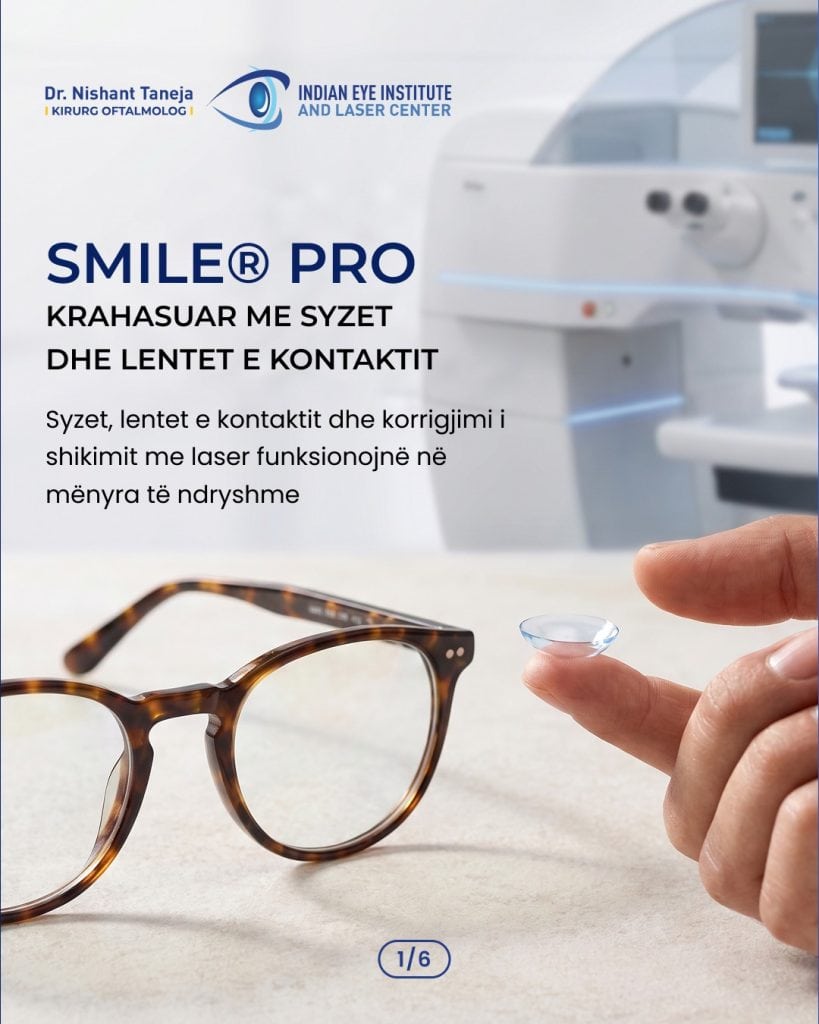
For laser eye surgery for myopia, we choose the method based on your prescription, corneal thickness and shape, and lifestyle. Indian Eye Institute & Laser Center (the Indian Eye Clinic) in Tirana is the only clinic in Albania offering SMILE Pro and the ZEISS VISUMAX 800 laser. Learn how the two main methods differ in our guide to SMILE Pro or Femto-LASIK.
Like any refractive surgery, laser surgery can also cause glare, halos around lights or poorer night vision. We explain these risks during your consultation, before you decide.
When can myopia be treated with laser surgery?
An eye examination—not just your glasses prescription—determines whether you are a candidate. In general, you must be over 18, your prescription must have remained stable for at least 12 months, your cornea must be healthy and thick enough, and you must not be pregnant or breastfeeding. Before laser surgery, we also rule out keratoconus, a corneal disease that often affects young people.
At our clinic, SMILE Pro treats myopia up to −10.00 D, while Femto-LASIK treats it up to −12.00 D. For higher prescriptions or a thin cornea, we assess other options, including an ICL lens, which can correct myopia up to −18.00 D, depending on the model and measurements.
Laser surgery does not prevent the need for reading glasses after age 40: these are caused by aging of the lens (presbyopia). There are other options for this; learn more about presbyopia correction.
High myopia and the retina: when should you seek urgent care?
People with high myopia are more likely to develop glaucoma, cataracts, macular degeneration, and retinal detachment. The risk of retinal detachment increases with the severity of myopia. That’s why we check the retina regularly in people with high myopia. A comprehensive eye exam also includes measuring eye pressure.
See an ophthalmologist the same day if you suddenly notice:
- flashes of light;
- many new spots or black strands;
- a dark shadow covering part of your vision.
These may be signs of retinal detachment, which requires urgent treatment. If you suddenly lose vision in one or both eyes, go to the emergency department immediately. Find other signs of retinal problems in our guide to retinal diseases.
Frequently asked questions
Can phones or screens cause myopia?
The exact cause of myopia is unknown. Many experts link the rise in myopia among children to more screen time and less time outdoors. That’s why we advise parents to make sure their children spend time outdoors every day and limit screen time.
Can I have laser surgery if I have high myopia?
It depends on the prescription and the cornea. At our clinic, SMILE Pro treats myopia up to −10.00 D and Femto-LASIK up to −12.00 D. For higher prescriptions or a thin cornea, we assess other options, such as an ICL lens.
Does my child need to wear glasses all the time?
We recommend how much and when to wear glasses based on the prescription. Uncorrected myopia in young children can be associated with strabismus or lazy eye, so regular checkups and the right glasses are important.
Sources
- American Academy of Ophthalmology — Nearsightedness: What Is Myopia?
- American Academy of Ophthalmology — Prescription for Keeping Children Out of Glasses: Sunshine
- American Academy of Ophthalmology — Implantable Collamer Lens (ICL)
- American Academy of Ophthalmology — What Is Keratoconus?
- National Eye Institute — Nearsightedness (Myopia)
- NHS — Short-sightedness (myopia)
- NHS — Vision loss
Are you nearsighted and want to know if you’re a candidate for laser surgery, or would you like to have your child’s myopia checked? Book an eye exam at Indian Eye Institute & Laser Center in Tirana. Book an appointment · Tel. +355 67 50 30 017