



In brief: If you’re wondering what an eye doctor is called, the answer is an oculist or ophthalmologist: in Albania and Kosovo, these are two names for the same specialist doctor. They have completed medical school and specialized in eye care, diagnose and treat eye diseases, and perform surgery. An optometrist tests your vision and determines your glasses prescription, but is not a doctor and does not perform surgery. An optician makes and fits glasses according to a prescription. If you have pain, redness, vision loss, or flashes of light, you need to see an ophthalmologist.
What is an eye doctor called in Albanian?
An eye doctor is called an oculist or an ophthalmologist. The word “oculist” comes from the Italian oculista, which the Treccani dictionary defines as a doctor who specializes in the study and treatment of eye diseases. “Ophthalmologist” comes from the Greek ophthalmós (“eye”), which also gives us the name of the medical specialty: ophthalmology.
In Albania, people more often search Google for “oculist,” while in Kosovo they search for “ophthalmologist.” In everyday conversation, people also say “eye doctor,” “oculist doctor,” or “eye specialist.” They all refer to the same doctor.
Oculist, optometrist, or optician: what’s the difference?
Three professions with similar-sounding names work in eye care. Their training and what they are allowed to do differ considerably.
| Oculist (ophthalmologist) | Optometrist | Optician | |
|---|---|---|---|
| Who they are | doctor specializing in eye care | vision care professional, not a doctor | glasses and contact lens technician |
| Tests vision and determines glasses prescription | po | po | jo |
| Prescribes glasses and contact lenses | po | po | no; makes them according to the prescription |
| Detects eye diseases | yes; diagnoses and treats all of them | detects some and refers you to a doctor | jo |
| Prescribes medication for eye diseases | po | some, only where permitted by law | jo |
| Performs eye surgery | po | jo | jo |
| When you see | eye diseases, symptoms, comprehensive eye exams, surgery | eyeglass prescriptions, contact lenses | buying and fitting glasses |
In Albanian, “optika” usually means an eyeglasses shop. Both optometrists and opticians may work there, so ask who will perform your test and what they will check.
What does an ophthalmologist do, and what can’t an optometrist do?
According to the American Academy of Ophthalmology (AAO), an ophthalmologist diagnoses and treats all eye diseases, performs eye surgery, and prescribes and fits glasses and contact lenses. They are the only one of the three with a medical degree. In the US, training takes 12 to 14 years in total: college, four years of medical school, and at least four years of medical and surgical training. Many ophthalmologists also complete one or two years of fellowship training in a specific part of the eye.
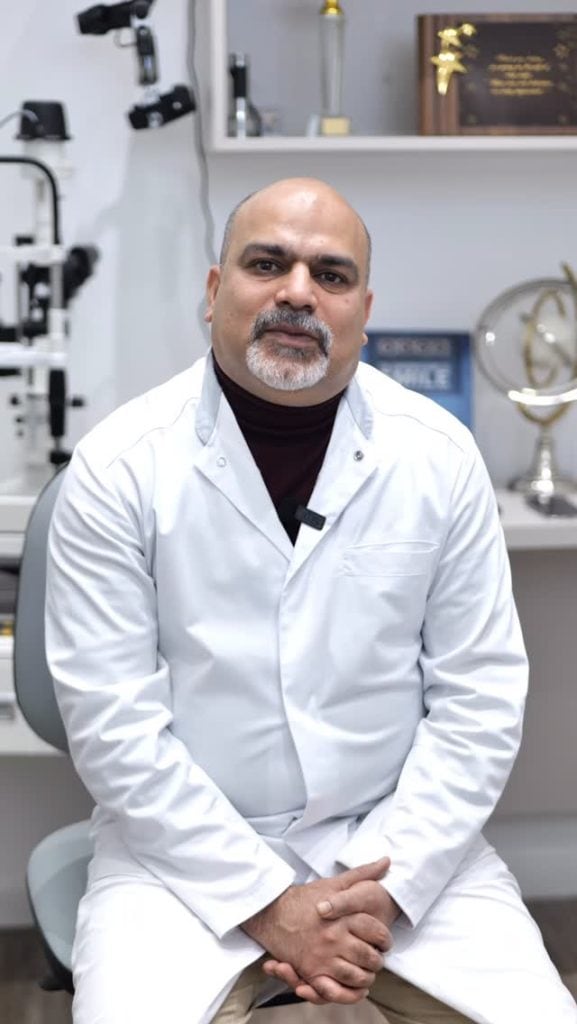
This is also the path taken by Dr. Nishant Taneja, an ophthalmic surgeon at the clinic: medical studies (MBBS), a specialization in ophthalmology (MD, AIIMS, New Delhi), and subspecialty training in the retina and vitreous (L.V. Prasad Eye Institute).
Optometrists are trained to recognize abnormal changes in the eye, such as signs of glaucoma or cataracts. They prescribe and fit glasses and contact lenses. If they find something that requires a doctor, they refer you to an ophthalmologist. They do not perform surgery: according to the AAO, only ophthalmologists have the medical training required for eye surgery.
Opticians make, check, and fit glasses and contact lenses. They do not test your vision, write prescriptions, or treat diseases.
When do you need an ophthalmologist, rather than just a prescription test?
A prescription test tells you what strength of glasses you need, not whether your eyes are healthy. According to the US National Eye Institute (NEI), many eye diseases cause no early symptoms. Open-angle glaucoma, for example, has no warning signs in its early stages. See an ophthalmologist if:
- you have diabetes or high blood pressure: most people with these conditions need an eye exam at least once a year;
- you are over 60 or have a family history of glaucoma: get an eye exam every 1–2 years;
- your vision changes, you see double, or you see flashes or shapes of light;
- your eye hurts or becomes red, or light bothers you;
- your optometrist or family doctor refers you for an examination;
- your child’s eye turns inward or outward;
- you are considering cataract surgery, laser vision correction, or retinal treatment.
Find out how often to get an eye exam at every age in our guide to how often you should have an eye test.
What does a comprehensive eye exam involve?
According to the NEI and AAO, a comprehensive eye exam includes:
- questions about your health, medications, glasses or contact lenses, and eye diseases in your family;
- distance and near vision, with the best possible eyeglass prescription;
- peripheral vision, eye movement, and how your pupils respond to light;
- eye pressure (tonometry), measured with a puff of air or a gentle touch;
- the front of the eye examined with a slit lamp: the eyelids, cornea, iris, and lens;
- the retina and optic nerve, after your pupils are dilated with eye drops.
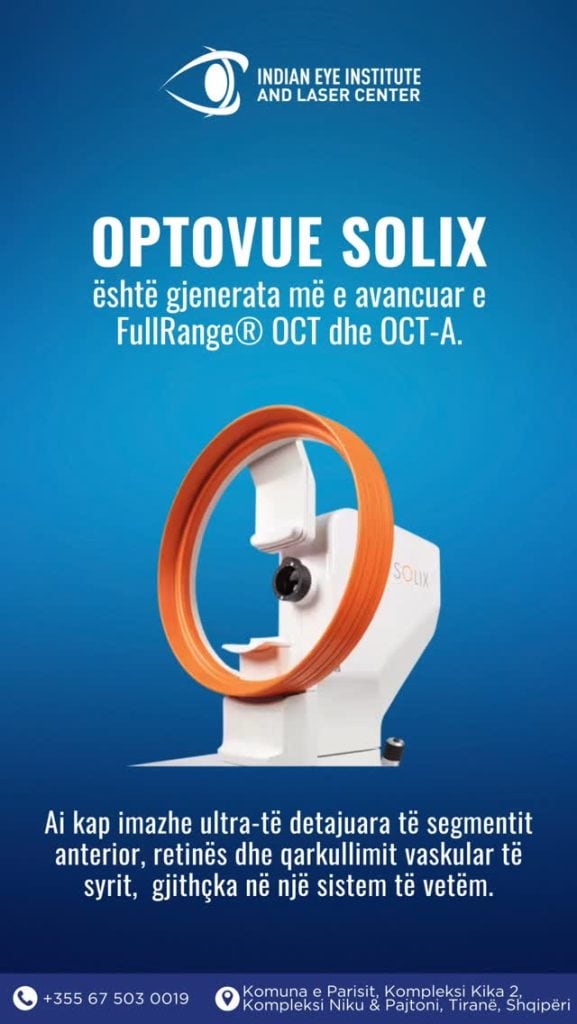
When needed, the ophthalmologist may perform additional tests, such as an OCT scan of the retina, retinal photography, or a visual field test. At the clinic, scans are performed using the Optovue Solix OCT and OCT-A. After the drops, your vision may be blurry and light may bother you for a few hours.
What are the subspecialties of ophthalmology?
After specializing, many ophthalmologists focus on a particular part of the eye. The AAO lists glaucoma, retina, cornea, pediatric ophthalmology, neuro-ophthalmology, and oculoplastics. The table shows what each subspecialty treats and what is offered by the Indian Eye Institute & Laser Center eye clinic in Tirana (Indian Eye Clinic), according to its website.
| Subspecialty | What it treats | At the clinic |
|---|---|---|
| Retina and vitreous (vitreoretinal) | macular degeneration, diabetic retinopathy, macular holes, retinal detachment | retinal detachment surgery, macular surgery, intravitreal injections, vitrectomy with Stellaris Elite 27-gauge |
| Cornea and refractive surgery | corneal conditions, keratoconus, myopia, and astigmatism | laser refractive surgery (SMILE Pro, Femto-LASIK, PRK), keratoconus, pterygium |
| Glaucoma | damage to the optic nerve, usually caused by fluid building up in the front of the eye | SLT laser treatment and glaucoma surgery |
| Pediatric ophthalmology and strabismus | strabismus, lazy eye (amblyopia), and children’s glasses prescriptions | strabismus in children and adults, amblyopia, tear duct conditions, cataracts, and congenital glaucoma |
| Oculoplastics | the eyelids, tear ducts, and eye socket | eyelid plastic surgery: ptosis, entropion, ectropion |
| Neuro-Ophthalmology | diseases of the optic nerve | optic neuropathies, within Dr. Taneja’s areas of practice |
Learn more about some of these: vitrectomy, strabismus in adults, and drooping eyelid (ptosis).
When should you see an ophthalmologist right away?
See an ophthalmologist or go to the emergency room immediately if:
- you suddenly lose vision in one or both eyes;
- you suddenly have severe eye pain;
- you have severe eye or forehead pain with redness, blurred vision, halos around lights, a headache, nausea, or vomiting: this could be an acute glaucoma attack;
- you get a chemical in your eye: rinse it immediately with plenty of clean water and seek urgent medical attention;
- your eye has been cut or has an object lodged in it: do not rub or press on it, and do not try to remove the object yourself.
See an ophthalmologist the same day if you see flashes or shapes of light, a dark shadow moving across your field of vision, or double vision, or if your eye is red and painful. The clinic has a video about chemical eye injuries. First-aid steps are explained in eye injury: what to do right away.
Frequently asked questions
Are an oculist and an ophthalmologist the same doctor? Yes. In Albania and Kosovo, both terms refer to a specialist eye doctor. Only the word differs: “oculist” comes from Italian, while “ophthalmologist” comes from Greek.
What is an eye doctor called in English and Italian? In English, ophthalmologist or eye doctor; in Italian, oculista or oftalmologo. An optometrist (English) and an optometrista (Italian) are not doctors.
Can an optometrist prescribe eye drops or perform surgery? An optometrist does not perform surgery. In some countries, they may prescribe certain eye medicines, depending on local law. You need an ophthalmologist to diagnose and treat eye diseases and to perform any surgery.
What should I bring to my ophthalmologist appointment? Bring your glasses or contact lenses and a list of your medications, as the doctor will ask about them. Also bring sunglasses and someone to drive you: after drops to dilate your pupils, your vision may be blurry for several hours.
Sources
- American Academy of Ophthalmology — What Is an Ophthalmologist vs Optometrist?
- American Academy of Ophthalmology — Eye Exam and Vision Testing Basics
- National Eye Institute (NEI) — Get a Dilated Eye Exam
- NHS — Visiting an optician
- NHS — Vision loss
- AAPOS — Difference between an Ophthalmologist, Optometrist and Optician
- AAPOS — Pediatric Ophthalmologist
- ASRS — What is a Retina Specialist?
- ASOPRS — Why Choose an ASOPRS Surgeon
- AAO — Glaucoma · AAO — Glaucoma symptoms
- AAO — Recognizing and Treating Eye Injuries
- Treccani — oculista
Do you need an eye exam? Book an ophthalmology appointment at Indian Eye Institute & Laser Center in Tirana. An examination will show how healthy your eyes are and whether you need treatment. Book an appointment · Tel. +355 67 50 30 017